
Research Brief
Half a Star Changed Everything: What a UC Berkeley Study Found About Online Ratings
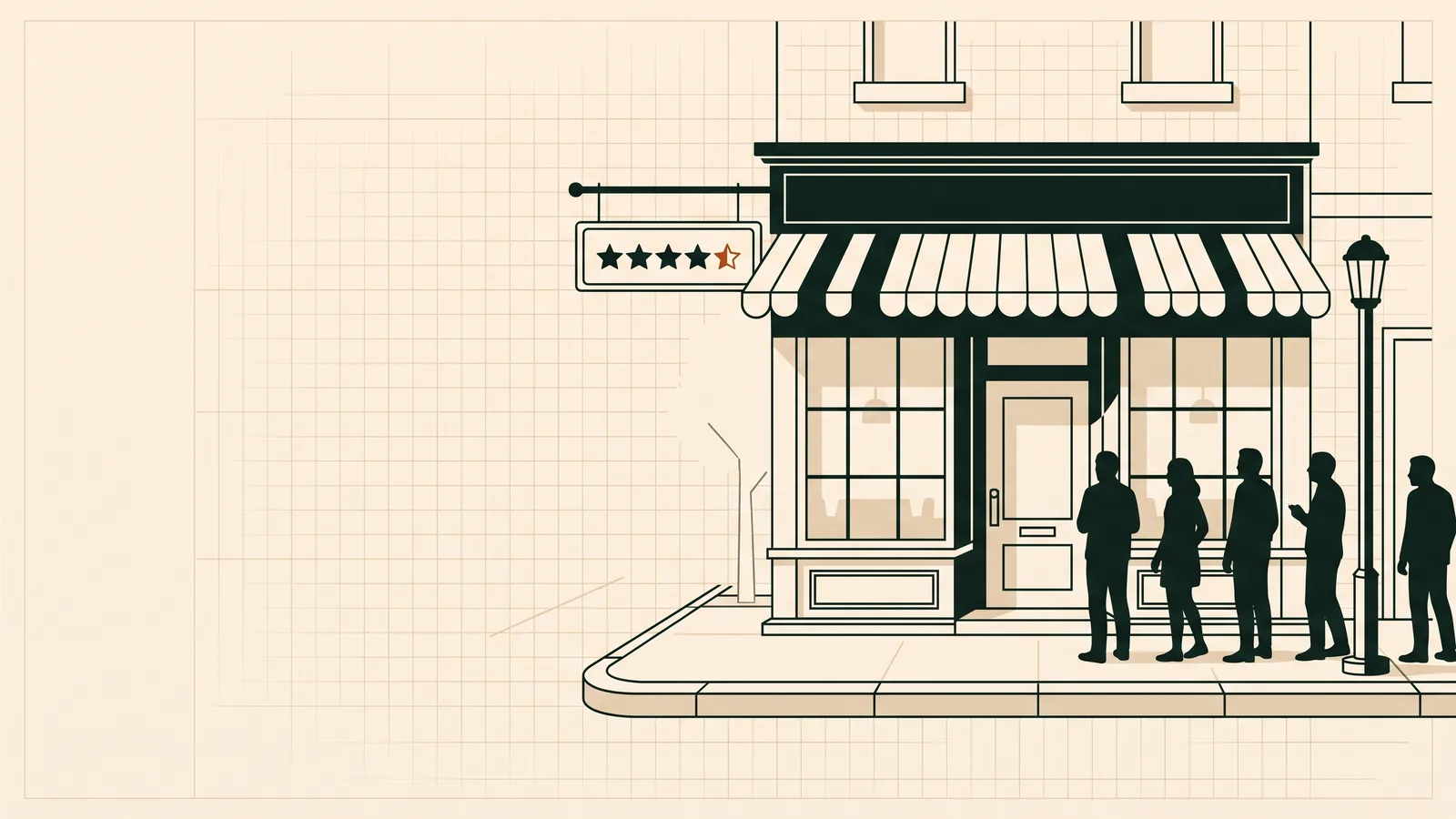
Most small-business owners have a gut feeling that online reviews matter. What’s harder to answer is how much, and whether reviews actually change customer behavior or just reflect what was going to happen anyway. Maybe great businesses get great reviews and great sales, and the stars are just along for the ride.
Two economists at UC Berkeley found a clever way to settle that question. Their answer: the number customers see on the screen moves real demand, by itself.
The study
Michael Anderson and Jeremy Magruder published “Learning from the Crowd: Regression Discontinuity Estimates of the Effects of an Online Review Database” in The Economic Journal in 2012. It’s a peer-reviewed journal, and the study’s design is the reason it gets cited so often.
Here’s the trick they used. Yelp calculates each business’s average rating to several decimal places but displays it rounded to the nearest half-star. A restaurant averaging 3.24 shows up as 3 stars. One averaging 3.26 shows up as 3.5 stars.
Those two restaurants are basically the same. Their real customer experience differs by a rounding error. But the number shoppers see is different by a full half-star. By comparing businesses that sit just above and just below each rounding line, the researchers could isolate the effect of the displayed rating, separate from the actual quality of the food or service.
They applied this to roughly 148,000 Yelp reviews across 328 restaurants in the San Francisco Bay Area, matched to data on whether those restaurants sold out of reservations at peak times.
What they found
According to UC Berkeley’s summary of the research:
- Moving from 3 to 3.5 stars raised a restaurant’s chance of selling out at prime dining times from 13% to 34%.
- Moving from 3.5 to 4 stars added roughly another 19 percentage points.
- For restaurants that weren’t already listed in established dining guides, a half-star increase was tied to a 27% greater likelihood of filled seats at peak times.
That last point matters most for most small businesses. The well-known, press-covered restaurants didn’t depend much on Yelp. Customers already knew about them. The ordinary neighborhood places with no other reputation signal were the ones whose fortunes moved with their star rating.
The fine print
Good research comes with limits, and these are worth knowing:
- It’s restaurants, in one metro area. The study shows the mechanism (ratings change who gets the business), not a guaranteed effect size for a plumber, a dentist, or a landscaper in 2026.
- It’s about displayed ratings on one platform. Today your customers might check Google, Yelp, Facebook, and industry-specific sites.
- Selling out isn’t the same as revenue. It’s a strong proxy for demand, but not a dollar figure.
Still, the core finding holds up: when shoppers can’t easily judge quality themselves, they lean on the rating, and a small difference in that number sends a large share of customers to one business instead of another.
What this means for your business
If you run a local service business, you’re in the same position as those unknown neighborhood restaurants. Most people searching for you haven’t heard of you. Your rating is often the first thing they see, and it may be the only thing they use to decide.
A few practical takeaways:
1. Treat your rating as a sales tool, not a vanity metric
The gap between a 3.5 and a 4.0 isn’t cosmetic. In this study it was the difference between an empty Tuesday and a full one. Track your average the way you’d track your close rate.
2. Make it easy for happy customers to leave reviews
Most satisfied customers never think to leave a review unless asked. A simple follow-up text or email with a direct link to your review page is often the single highest-return marketing step a small business can take. Your website should have a clear “Leave us a review” path too.
3. Give your reviews a home you control
Review platforms come and go, and their layouts change. Your website is the one place you can showcase your best reviews, respond to common questions, and present your reputation on your terms. When a prospect lands on your site after seeing your rating, the site should confirm what the stars suggested.
4. Respond to reviews, good and bad
Prospects read beyond the number. A thoughtful reply to a critical review often reassures people more than another five-star rating would.
5. Don’t game it
Fake reviews violate platform rules, can bring penalties, and erode the very trust that makes ratings valuable. The goal is to collect the honest reviews you’re already earning but not capturing.
The bottom line
This study is one of the cleanest pieces of evidence we have that online reputation causes changes in customer demand, rather than just reflecting it. And the effect was strongest for exactly the kind of business most of our clients run: good, local, and not yet famous.
Your website and your review presence work together. Ratings get you considered; your site closes the deal. If either one is underselling you, you’re leaving customers on the table.
Want to make your reputation easier to find and harder to ignore? Get in touch with Callsign Studio and we’ll show you how your site can put your best reviews front and center.
Source
Anderson, M. & Magruder, J. (2012). “Learning from the Crowd: Regression Discontinuity Estimates of the Effects of an Online Review Database.” The Economic Journal, 122(563), 957–989. https://doi.org/10.1111/j.1468-0297.2012.02512.x
Plain-language summary: UC Berkeley News, “Yelp reviews boost restaurant business”